CAVEATS UNDER THE LAWS OF UGANDA: WHAT EVERY LANDOWNER AND BUYER SHOULD KNOW


Land disputes in Uganda can begin in very ordinary ways.
A person buys a piece of land, pays the agreed amount, and believes the transaction is complete. They may even begin planning what they will build on the land. But before the transfer is registered, they discover that the seller has attempted to sell the same land to someone else.
In another situation, a person may have a legitimate interest in registered land but may not yet appear on the land title. The fear is often the same: What happens if someone deals with the land before my interest is formally recognised?
This is where a caveat can become an important legal safeguard.
What is a caveat?
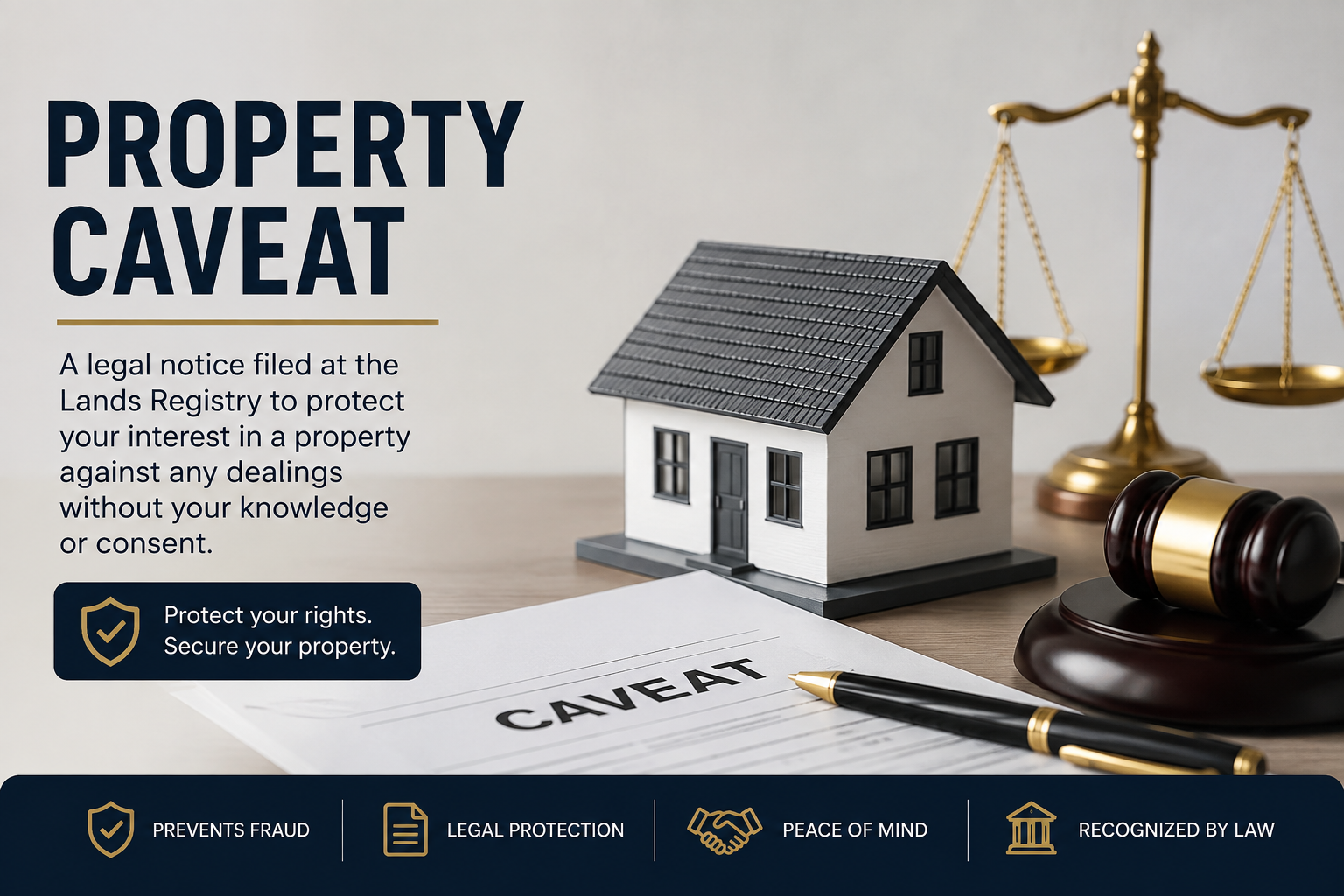
A caveat is a legal mechanism used to protect a person’s claimed interest in registered land. It serves as a formal warning to the Registrar of Titles that someone other than, or in addition to, the registered proprietor claims an interest in the land.
In simple terms, a caveat tells the land registration authorities:
“I have an interest in this land. Do not allow a transaction affecting my interest to proceed without dealing with my claim in accordance with the law.”
The principal law governing land caveats in Uganda is the Registration of Titles Act, Cap. 230, particularly section 139.
A caveat is therefore not simply a way of “stopping someone from selling land.” Its purpose is to protect a genuine interest in registered land within the land registration system.
Who can lodge a caveat?
One common misunderstanding is that only the person whose name appears on the land title can lodge a caveat.
That is not necessarily the case.
A person who has acquired a recognised interest in land, but whose interest has not yet been registered, may in appropriate circumstances seek to protect that interest through a caveat.
For example, imagine that Peter enters into a valid agreement to purchase registered land from John. He pays the agreed purchase price, and the parties begin the process of transferring the land into his name. Before the transfer is completed, Peter learns that John is attempting to sell the same property to another buyer.
Peter may have grounds to protect his interest through a caveat, provided the statutory requirements are satisfied.
Similar situations may arise in which a person claims an interest under an unregistered lease or mortgage, or in which an interest has arisen through succession or another form of devolution.
The important point is that being absent from the land title does not automatically mean that a person has no interest worth protecting.
However, a caveat should not be used simply because someone fears losing land or wants to put pressure on another party. There must be a genuine legal or equitable interest capable of protection.
Why is a caveat important?
The main purpose of a caveat is to prevent a person’s legitimate interest from being defeated by a subsequent dealing with the land.
Registered land can be transferred, mortgaged, leased or otherwise dealt with. If a person has a genuine interest that has not yet been registered, a caveat may provide an important layer of protection while the person takes the necessary legal steps to establish or enforce that interest.
For someone who has paid for land but has not yet completed registration, for instance, a caveat can help prevent the situation from becoming even more complicated by allowing another transaction to proceed without the claimant being brought into the process.
This does not mean that a caveat gives the caveator absolute control over the land. Rather, it operates within the land registration system and imposes legal restrictions on dealings according to the terms and requirements of the law.
What does a caveat actually do?
Once properly lodged, a caveat can restrict the registration of certain dealings affecting the land.
Depending on the circumstances and the terms of the caveat, it may prevent the registration of a transfer, mortgage, lease or other instrument affecting the claimed interest unless the requirements of the law have been met.
The caveator may therefore receive the notice required by law, consent to the proposed dealing, or have the dealing made subject to the caveator’s claim, depending on the circumstances.
This is particularly important because land transactions can sometimes move quickly. By the time a person discovers that the registered proprietor has transferred or otherwise dealt with the land, the situation may have become significantly more difficult to resolve.
A caveat can therefore act as an early warning mechanism within the registration system.
What a caveat does NOT do
Perhaps the most important thing to understand is that a caveat does not make you the owner of land.
Lodging a caveat does not automatically:
- transfer ownership to the caveator;
- put the caveator’s name on the land title;
- establish that the caveator’s claim is legally valid;
- finally determine a land dispute; or
- give the caveator unlimited power to prevent all future dealings with the land.
A person cannot simply lodge a caveat and assume that the land now belongs to them.
If there is a serious dispute about ownership, fraud, breach of a sale agreement or another substantive legal issue, the parties may ultimately need to go to court or pursue another appropriate legal remedy.
This distinction is important because a caveat protects a claim; it does not finally determine the claim.
What is required to lodge a caveat?
A person seeking to lodge a caveat must comply with the applicable legal and procedural requirements.
Generally, the caveator must identify themselves, state the nature of the interest they are claiming and use the prescribed form and procedure.
Depending on the circumstances, supporting documentation may be important in demonstrating the basis of the claimed interest. This may include:
- a sale agreement;
- evidence of payment;
- a lease agreement;
- a mortgage agreement;
- letters of administration or other succession documents;
- court documents; or
- other documents supporting the claimed interest.
A statutory declaration may also be required depending on the circumstances and the applicable procedure.
This is why keeping proper documentation when dealing with land is extremely important.
A handshake, a verbal promise or an informal understanding may not provide the same evidential protection as a properly documented transaction.
A real-life perspective: why documentation matters
Consider a person who pays a substantial amount of money for land based largely on trust.
The seller tells them, “The land is yours; we shall complete the transfer later.”
Months pass.
The buyer discovers that the seller has either attempted to sell the same land to someone else, taken out a mortgage over it, or entered into another transaction affecting the property.
At that point, the buyer may realise that proving what happened is much harder than expected.
This is why people should not wait for a land dispute to arise before taking documentation seriously.
Before purchasing land, it is important to conduct appropriate searches, verify ownership, properly document the transaction and understand what steps are required to complete registration.
A caveat can be useful, but it should not be viewed as a substitute for proper due diligence.
Can a caveat be removed?
Yes.
A caveat is not necessarily permanent.
It may be withdrawn where the dispute has been resolved, the claimant’s interest has been satisfied, the caveator consents to the transaction, or the parties reach a settlement.
A caveat may also be challenged or removed through the procedures provided by law, including where an affected person seeks appropriate court intervention.
This is important because a caveat should not be understood as an indefinite freeze on someone’s land.
If a person has lodged a caveat without a genuine interest, or if the circumstances giving rise to the caveat no longer exist, the affected proprietor or other interested person may have legal avenues to challenge it.
Caveat versus injunction: are they the same?
No.
Although both may be used in situations involving a disputed interest in land, they operate differently.

A caveat operates primarily through the land registration system. It places a restriction or warning against dealings with registered land in accordance with the law.
An injunction, on the other hand, is a court order restraining a person from doing a particular act or requiring them to take a particular action.
For example, where a dispute has escalated, and there is a risk that a party will sell, develop, transfer or otherwise interfere with disputed property, a court may, depending on the circumstances, be asked to issue an injunction.
A caveat and an injunction can therefore serve different purposes, and one should not automatically be treated as a substitute for the other.
What happens when there is a serious land dispute?
A caveat may provide temporary protection, but it may not resolve the underlying dispute.
Suppose two people are claiming ownership of the same property. One says they purchased it, while the other says they are the rightful owner. A caveat may help preserve the claimant’s position within the registration system, but it does not answer the ultimate question:
Who legally owns the land?
That question may require a substantive legal process.
Depending on the facts, a claimant may seek remedies such as a declaration of ownership, specific performance, an injunction, cancellation or rectification of title, or damages.
The appropriate remedy will depend on the circumstances of each case.
This is why a person facing a land dispute should not assume that lodging a caveat is the end of the matter. It may only be one step in protecting an interest while the substantive dispute is addressed.
Caveats in succession matters: an important distinction
The word “caveat” is also used in succession matters, which can sometimes cause confusion.
A land caveat is concerned with an interest in registered land and is dealt with through the land registration system.
A succession caveat, on the other hand, relates to proceedings concerning probate or letters of administration.
Although they share the same term, they serve different purposes and operate in different legal contexts.
Anyone dealing with a caveat should therefore first establish what type of caveat is being discussed and which legal procedure applies.
What should ordinary Ugandans take away from this?
For many people, land is more than an asset recorded on a certificate of title. It may be a family home, a farm, a business investment, inherited property or the result of years of saving.
That is why land transactions should never be approached casually.
A caveat can be an important legal safety mechanism where a person has a genuine interest in registered land that needs protection. But it is only one part of a much larger land registration and dispute-resolution framework.
Before buying land, people should conduct proper searches and verify the registered proprietor and any existing interests or encumbrances. Transactions should be properly documented, and parties should understand the steps required to complete registration.
Where a dispute has already arisen, seeking appropriate legal advice early can make a significant difference.
Conclusion
A caveat is best understood as a protective legal tool, not a shortcut to ownership.
It can help protect a genuine interest in registered land and prevent that interest from being quietly defeated through a subsequent transaction. At the same time, it does not finally establish ownership, resolve every dispute or permanently prevent the registered proprietor from dealing with the property.
The strength of a caveat ultimately depends on the legitimacy of the interest behind it and compliance with the law.
For anyone buying, inheriting, leasing, mortgaging or otherwise acquiring an interest in land in Uganda, the lesson is simple: know your interest, document it properly, conduct due diligence and act early when that interest is threatened.
A caveat can provide an important layer of protection, but it should be used responsibly, for a genuine claim, and as part of the wider legal framework governing land in Uganda.