Can WhatsApp Messages Be Used as Evidence in Criminal Proceedings in Uganda?


A threatening WhatsApp message. A voice note demanding money. A conversation discussing a crime. A screenshot showing an admission.
Today, much of our everyday communication happens on our phones, and WhatsApp has become one of the platforms where people communicate, conduct business, exchange documents and share personal information. But what happens when those conversations become relevant to a criminal case?
Can a WhatsApp message actually be used as evidence in a Ugandan court?
The short answer is yes. However, simply producing a screenshot does not automatically prove what happened. Like other forms of electronic evidence, WhatsApp communications must satisfy legal requirements relating to authenticity, reliability and relevance before a court can safely rely on them.
What does Ugandan law say?
The Electronic Transactions Act, 2011 provides the legal foundation for the recognition of electronic records in Uganda.
Under section 5 of the Act, information cannot be denied legal effect, validity or enforcement simply because it exists wholly or partly in electronic form. This means that the law recognises that information stored or communicated electronically can have legal significance.
More importantly, section 8 addresses the admissibility and evidential weight of electronic records. It provides that an electronic record should not be denied admissibility merely because it is electronic or because it is not in its original form.
But there is an important requirement: authenticity must be proved.
Under section 8(2), a person seeking to introduce an electronic record in legal proceedings bears the burden of presenting evidence capable of showing that the electronic record is what they claim it to be.
The court may therefore consider factors such as how the message was generated, stored or communicated; whether its authenticity was maintained; how the person who originated it was identified; and any other circumstances relevant to determining its reliability.
Section 7 of the Act further addresses authenticity by considering, among other things, whether the information has remained complete and unaltered.
In practical terms, the question is not simply, “Do you have the WhatsApp message?” The court may also need to know: “Can you show that this message is genuine and that it came from the person you say sent it?”
What have Ugandan courts said?
Recent decisions demonstrate why this distinction matters.
In Uganda v Lubinga (Criminal Session 6 of 2022) [2025] UGHCACD 4, decided by the High Court Anti-Corruption Division on 3 March 2025, the court considered electronic evidence that included WhatsApp communications and audio recordings.
The electronic evidence was considered alongside the complainant’s testimony and other evidence in a case involving solicitation and receipt of gratification. The court found the evidence sufficient to support the prosecution’s case and convicted the accused. The case demonstrates how WhatsApp communications, when properly supported by other evidence, can play an important role in proving a criminal case.
But electronic evidence does not automatically succeed simply because it exists.
In Mumbere Godwin v Uganda (Criminal Appeal 7 of 2024) [2026] UGHC 166, decided on 26 February 2026, the High Court dealt with electronic handset-tracking evidence. Although the case did not specifically concern WhatsApp messages, it provides an important lesson about authentication.
The prosecution relied on a handset-tracking report to connect the accused to the offence. However, the witness who introduced the report was neither an employee of MTN Uganda nor a police officer and could not properly establish the authenticity of the electronic record.
The High Court found that the prosecution had failed to discharge the burden of authenticating the electronic evidence as required by the Electronic Transactions Act. Because the tracking evidence had been central to connecting the accused to the offence, the court ultimately quashed the conviction and acquitted him.
A screenshot alone may not tell the whole story
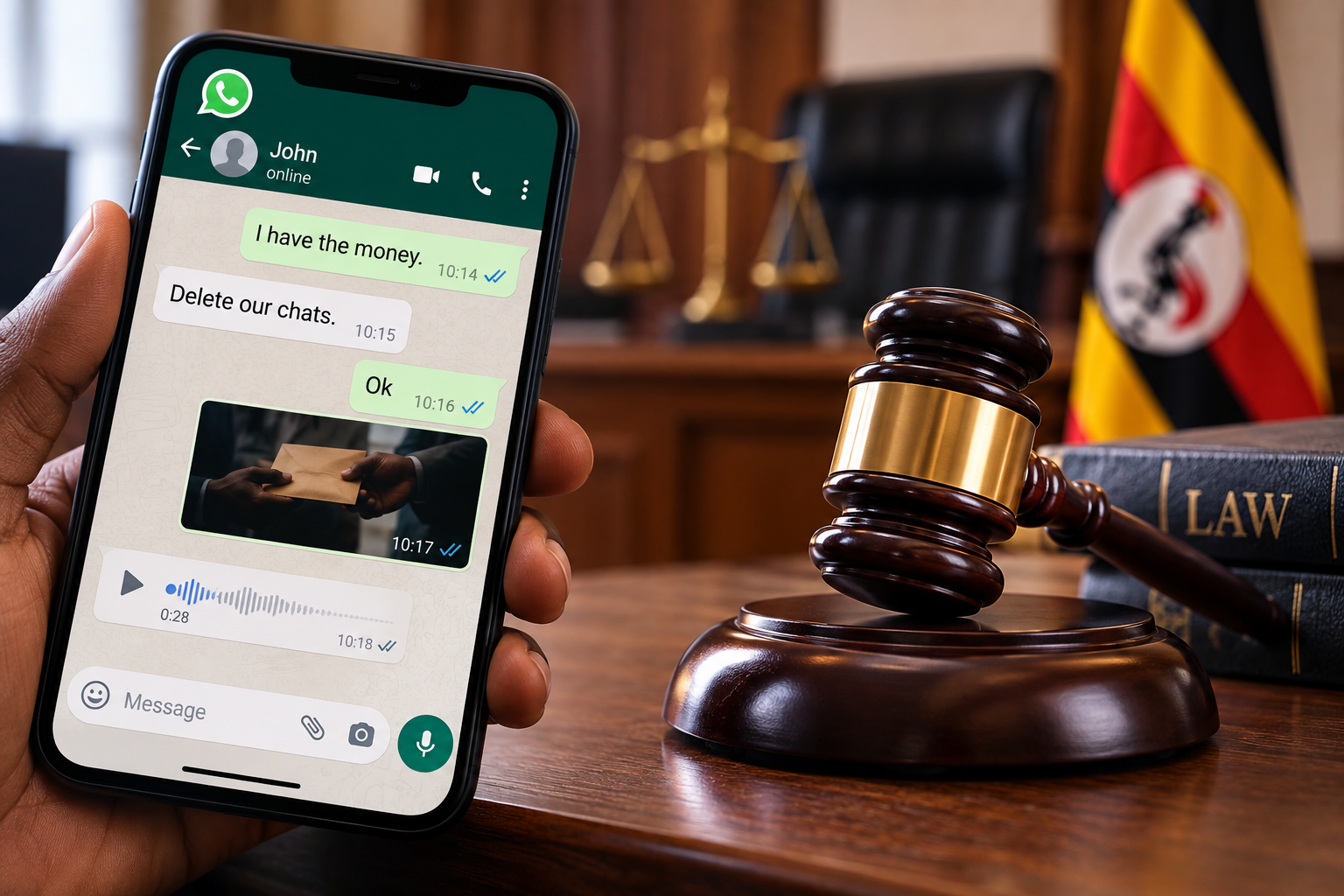
Imagine receiving a WhatsApp screenshot showing a message that reads:
“I have the money. Delete our chats.”
At first glance, the message may appear incriminating. But several questions immediately arise.
Who sent it? Who received it? Does the phone number belong to the accused person? Is the screenshot complete, or has part of the conversation been removed? Has the image been edited? Is the original conversation still available on the device? When was the message sent? And what was the context of the conversation?
These questions matter because screenshots can be cropped, forwarded, altered, or taken out of context.
For that reason, where WhatsApp communications are likely to become evidence, preserving the original device and the complete conversation may help establish authenticity. Other evidence may also be used to connect the communication to its alleged sender and to the offence under investigation.
Admissibility does not necessarily mean guilt
There is also an important distinction between admissibility and evidential weight.

A court allowing a WhatsApp message to be admitted into evidence does not automatically mean that everything contained in the message has been proved, nor does it automatically establish the guilt of an accused person.
The court must still assess the evidence in the context of the entire case.
For example, a WhatsApp conversation may be authentic but have little connection to the offence charged. Another message may be highly relevant but require additional evidence to establish who actually sent it. Electronic evidence therefore has to be considered together with witness testimony, forensic evidence and other relevant evidence presented before the court.
What should you do if WhatsApp messages may become evidence?
If a WhatsApp conversation relates to a criminal matter, avoid deleting, editing or unnecessarily altering the communication. Where possible, preserve the original phone and the full conversation rather than relying exclusively on cropped screenshots.
Investigators and prosecutors may also need to establish how the electronic information was obtained, preserved and connected to the person alleged to have sent it.
This is particularly important in an age where messages, screenshots and even audio recordings can increasingly be manipulated.
The bottom line
Yes, WhatsApp messages can be used as evidence in criminal proceedings in Uganda.
The Electronic Transactions Act, 2011 recognises electronic records and provides a framework for their admission in legal proceedings. However, the fact that a message appears on a phone or in a screenshot does not automatically make it reliable or conclusive evidence.
The person relying on the electronic record must be able to establish its authenticity, while the court considers its integrity, origin, reliability, relevance and overall evidential weight.
The decisions in Uganda v Lubinga and Mumbere Godwin v Uganda illustrate both sides of that principle: electronic evidence can strengthen a criminal prosecution when properly supported, but failure to establish its authenticity can seriously undermine a case.
As more of our lives move online, our digital conversations increasingly leave behind potential evidence. The law may recognise that evidence,but the central question remains whether it can be shown to be genuine, reliable and connected to the case before the court.